Materials · Video & Carbon Protocol Deck

COMET.

A Shared Carbon Language — Explainer Video & v0.1 Public Draft Deck

An at-a-glance walkthrough of the COMET protocol — why product-level carbon variance now drives financial outcomes, how the seven-layer semantic stack works, and the regulatory forcing functions on the 2025–2028 roadmap. Use the video as an introduction; use the deck and the slide summaries below to drill into each layer, namespace, and governance mechanism.

Video~6 min · MP4 · 33 MB
Deck14 slides · PPTX · 15 MB
LicenseCC BY 4.0 + Apache 2.0
StatusPublic Draft · RFC Open
Repositorygithub.com/nickgogerty/comet-ontology
COMET: A Shared Carbon Language
A short narrated walkthrough of the protocol, paired with the v0.1 Carbon Protocol deck below. Covers the market problem (untranslatable data siloes), the seven-layer architecture, standards interoperability, and the adoption flywheel.

What the video covers

The market problem. Every company measures carbon differently, every platform stores it differently, every regulator demands it differently. Without a shared vocabulary, carbon data is siloed, incomparable, and untradeable.

The COMET answer. A neutral, openly-governed JSON-LD ontology — the TCP/IP for carbon data — that wraps existing standards (ISO 14067, PACT v3, EU CBAM, GHG Protocol, IRA 45V) via owl:equivalentClass mappings rather than replacing them.

Where it goes. A seven-layer stack from raw activity data to market-priced carbon premiums, with unbroken provenance from physical meter to regulatory tariff. Pair with the slide summaries below to drill into each layer.

The Semantic Protocol for Carbon Data — v0.1 Public Draft
A 14-slide narrative built in NotebookLM that traces the path from market variance, through the seven-layer architecture, into compliance hooks (CBAM, IRA 45V, CSRD, EN 15804) and the community governance model. Designed for board, investor, regulator, and partner conversations.

14 slides · From carbon variance to community governance

The deck opens on the financial reality — products below benchmark carbon intensity earn premiums, products above face CBAM tariffs and supply-chain discounts — and then walks the underlying digital infrastructure that makes this variance machine-readable and tradeable.

Each slide below links to the part of the ontology, namespace, or governance structure it depicts. Slide thumbnails are rendered at 100 dpi for fast loading; the original PPTX is the canonical source.

↓ Download deck (PPTX, 15 MB)
Slide 01 — The Semantic Protocol for Carbon Data, COMET v0.1 Public Draft title slide.
Fourteen visualizations, fourteen arguments
Each card distills one slide into a single paragraph and lists the COMET classes or namespaces it touches. Read top-to-bottom for the full narrative arc, or jump to the slide that maps to your role.
Title slide showing The Semantic Protocol for Carbon Data.
Slide 01 · Title
The Semantic Protocol for Carbon Data
Opens the deck under the v0.1 Public Draft banner. Establishes the namespace, license, and governance posture before any technical content lands.
comet.carbon/v1/ CC BY 4.0 + Apache 2.0 RFC Open
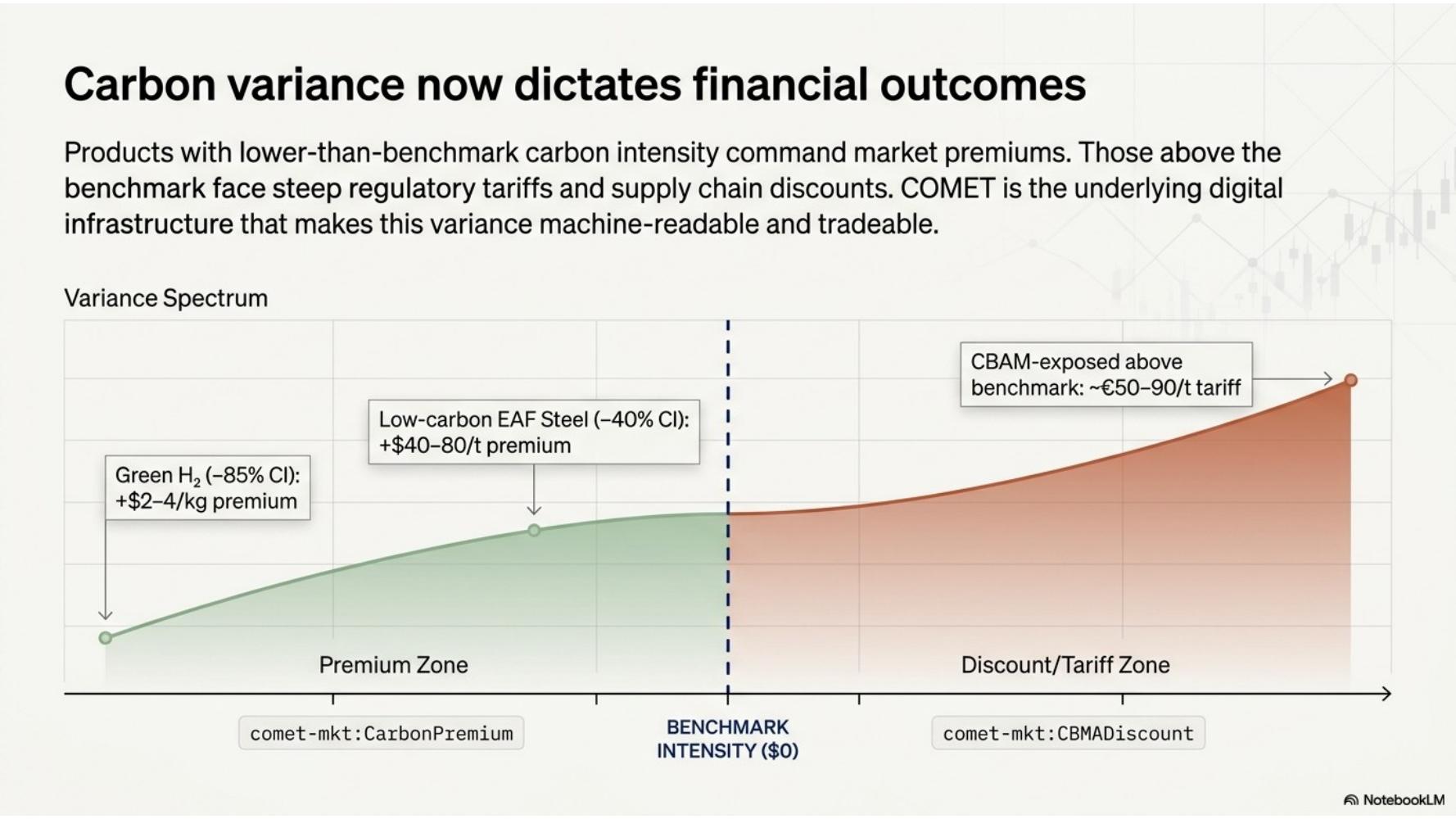
Variance spectrum chart showing carbon premium and discount zones.
Slide 02 · Why this matters
Carbon variance now dictates financial outcomes
Products with lower-than-benchmark intensity earn premiums (green H₂ +$2–4/kg, low-carbon EAF steel +$40–80/t); products above face CBAM-style tariffs of ~€50–90/t. COMET is the digital infrastructure that makes that variance machine-readable.
comet-mkt:CarbonPremium comet-mkt:CBMADiscount
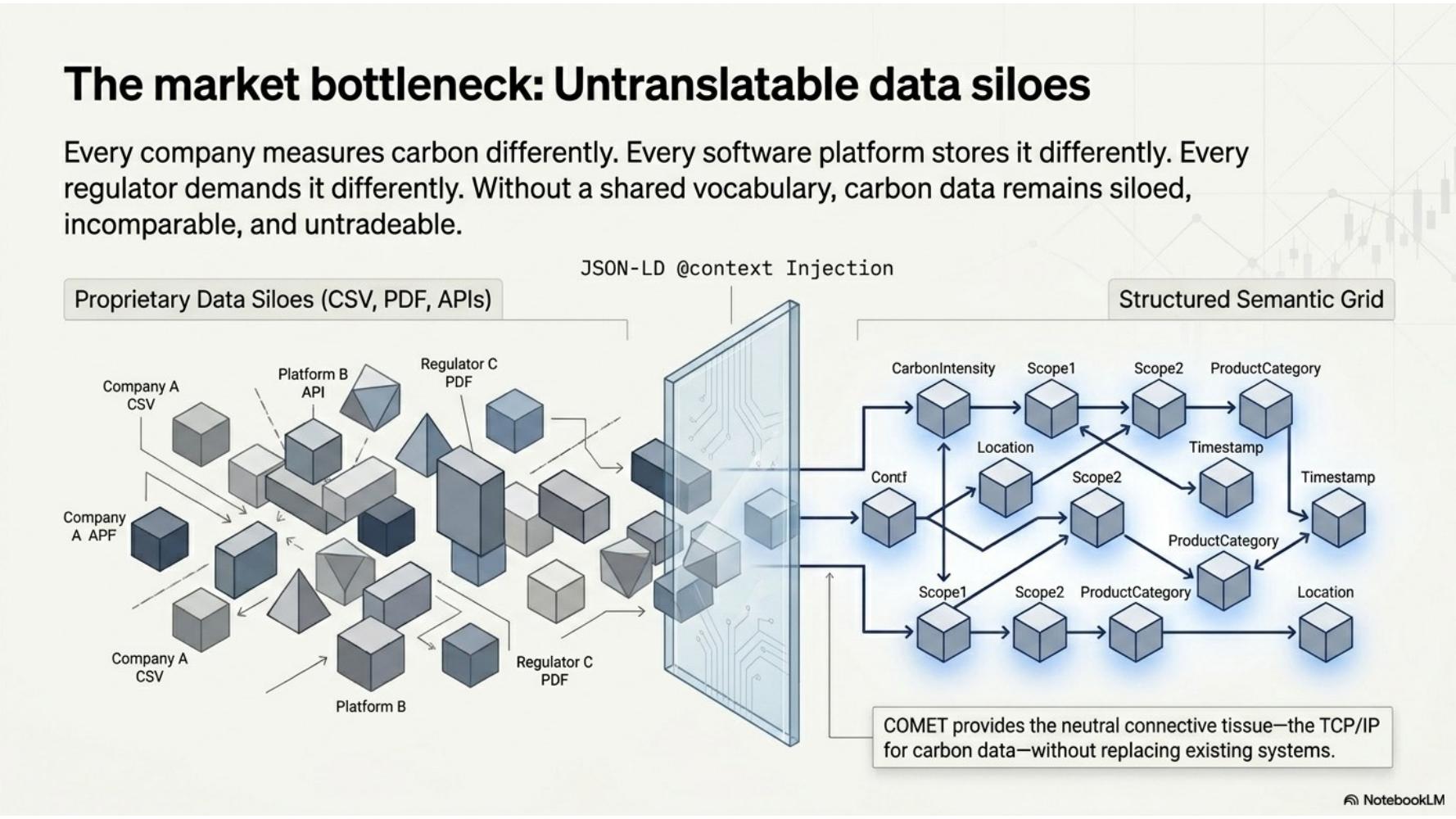
Diagram of proprietary data siloes converging through JSON-LD context injection into a structured semantic grid.
Slide 03 · The bottleneck
Untranslatable data siloes
Every company, platform, and regulator stores carbon data differently. COMET injects a JSON-LD @context that maps proprietary CSV / PDF / API payloads into a shared semantic grid — without replacing existing systems. The TCP/IP for carbon data.
JSON-LD @context Semantic grid
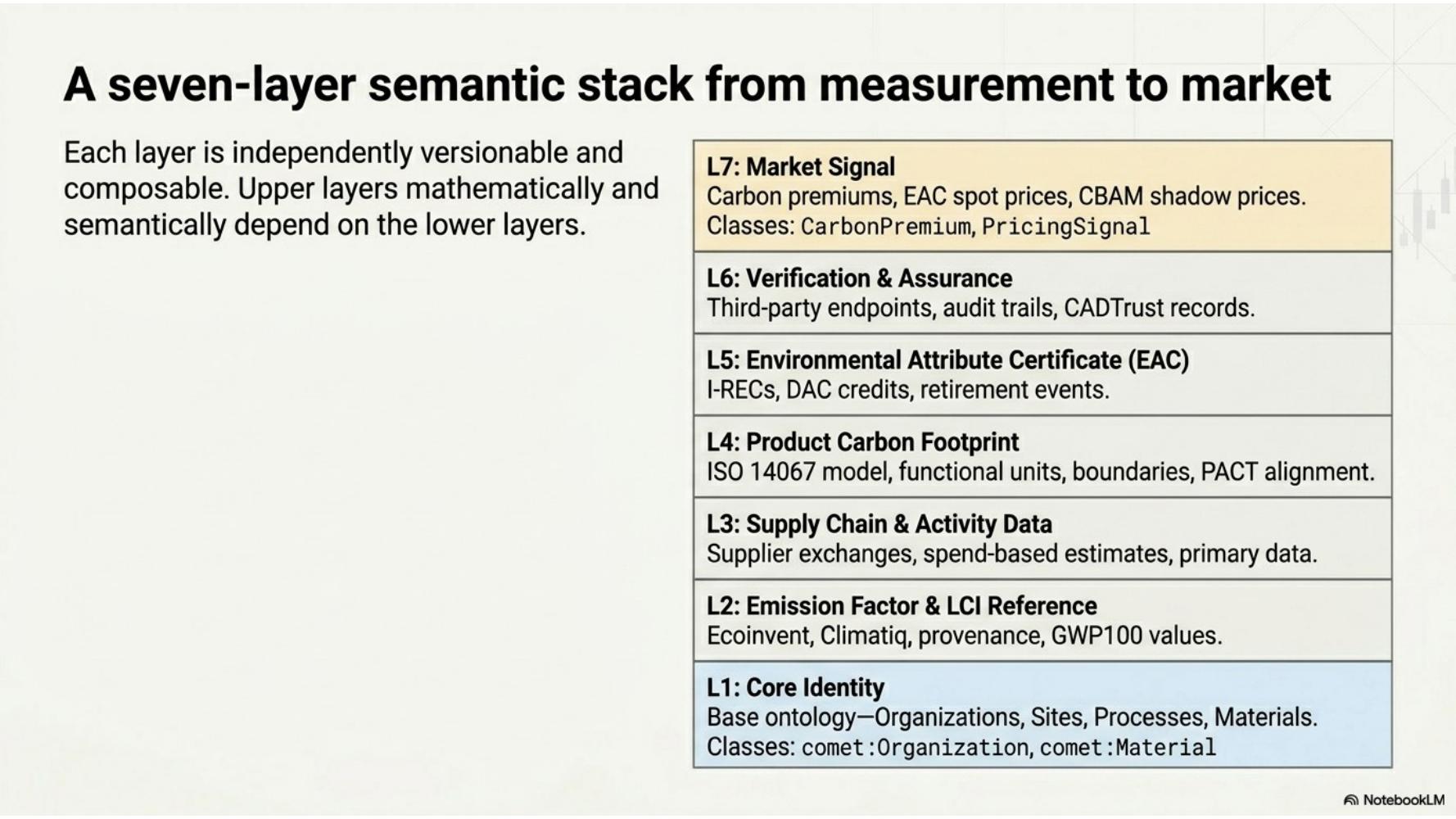
Stacked diagram of the seven COMET layers from L1 Core Identity to L7 Market Signal.
Slide 04 · Architecture
A seven-layer semantic stack from measurement to market
L1 Core Identity → L2 Emission Factor & LCI → L3 Supply Chain & Activity → L4 Product Carbon Footprint (ISO 14067) → L5 Environmental Attribute Certificate → L6 Verification & Assurance → L7 Market Signal. Each layer is independently versionable; upper layers depend on lower.
comet:Organization comet:Material CarbonPremium
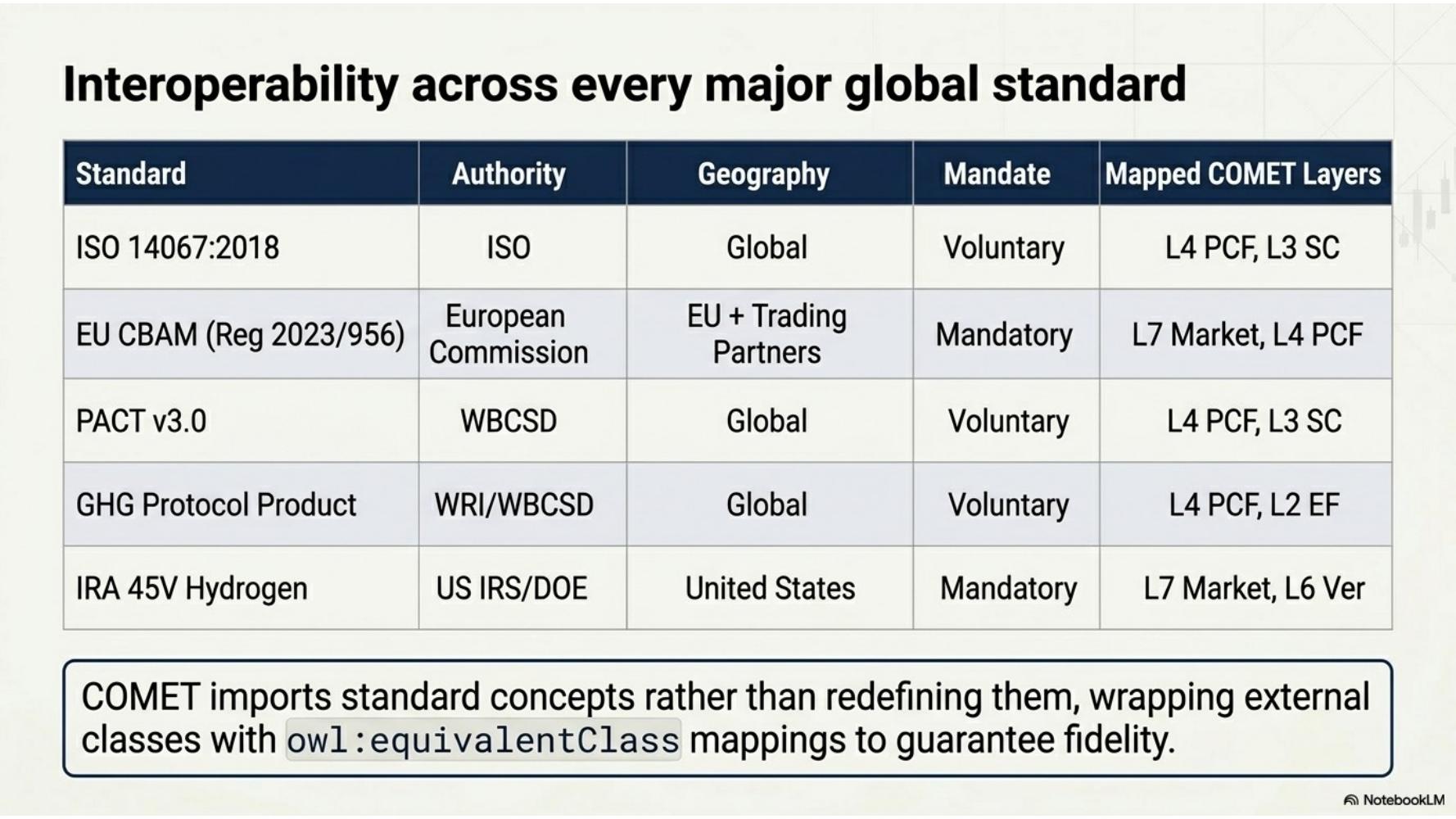
Standards interoperability table mapping ISO, CBAM, PACT, GHG Protocol, and IRA 45V to COMET layers.
Slide 05 · Standards map
Interoperability across every major global standard
ISO 14067:2018, EU CBAM (Reg. 2023/956), WBCSD PACT v3.0, GHG Protocol Product, and IRA 45V all map onto specific COMET layers. COMET imports rather than redefines — every external concept is wrapped via owl:equivalentClass to guarantee fidelity.
ISO 14067 EU CBAM PACT v3 IRA 45V
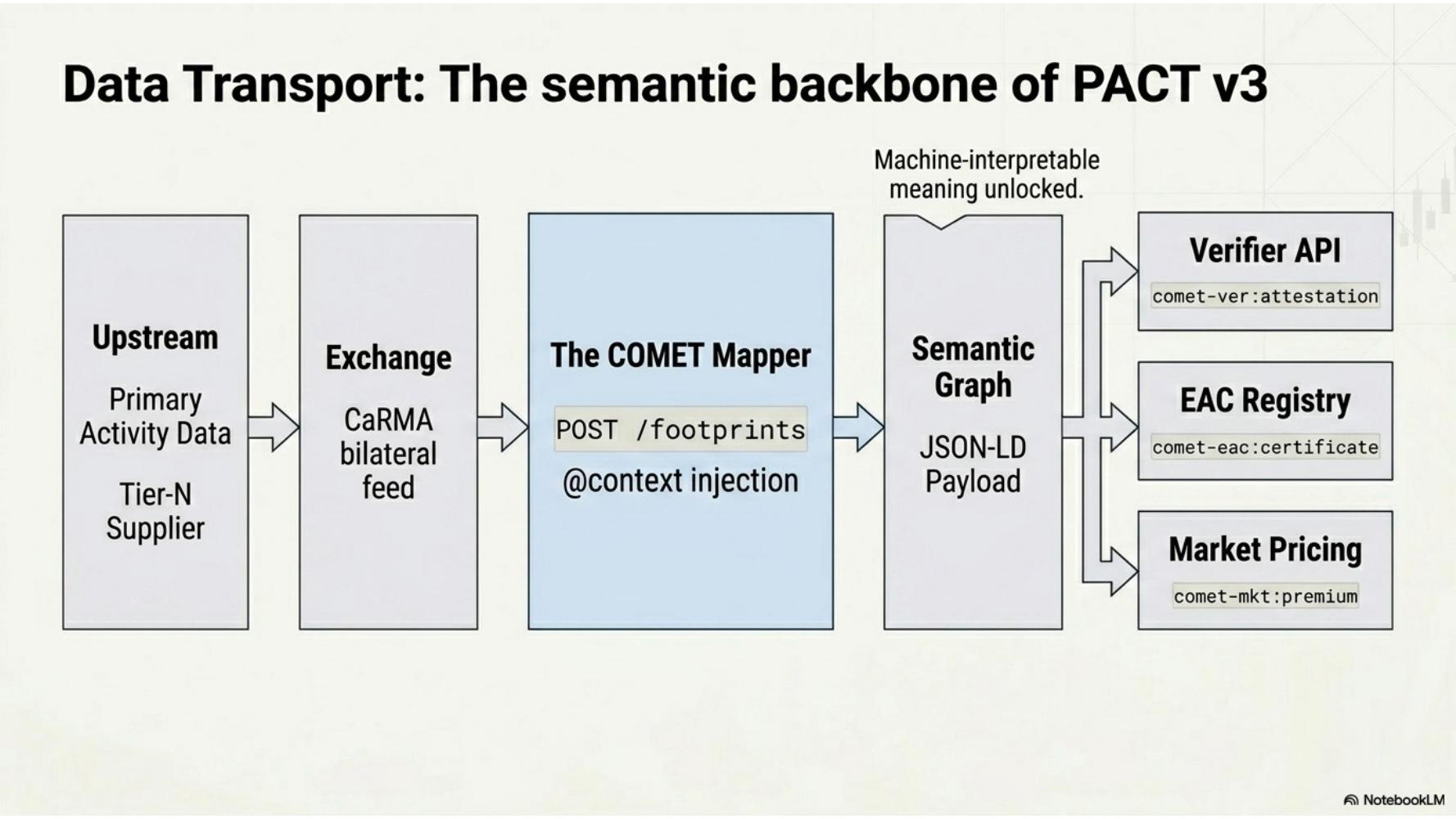
Pipeline diagram showing primary activity data flowing through CaRMA exchange, the COMET mapper, into JSON-LD payloads consumed by verifier API, EAC registry, and market pricing.
Slide 06 · Data transport
The semantic backbone of PACT v3
Upstream primary data → CaRMA bilateral feed → COMET Mapper (POST /footprints with @context injection) → JSON-LD semantic graph → fanned out to Verifier API, EAC Registry, and Market Pricing endpoints. Machine-interpretable meaning is unlocked at the mapper.
comet-ver:attestation comet-eac:certificate comet-mkt:premium
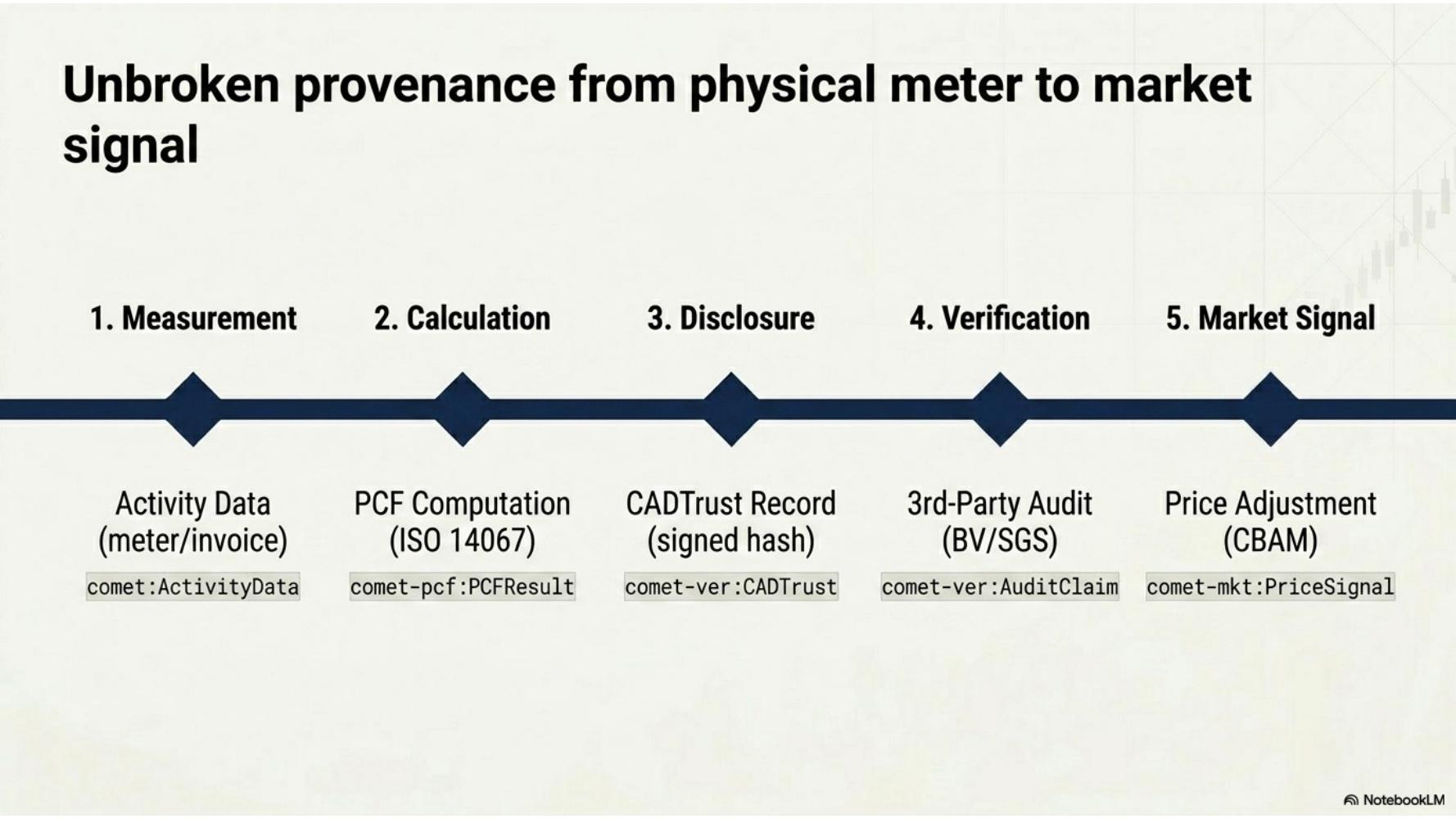
Five-step provenance timeline from activity data to price adjustment.
Slide 07 · Provenance
Unbroken provenance from physical meter to market signal
Five typed steps with named classes: Activity Data (meter / invoice) → PCF Computation (ISO 14067) → CADTrust Record (signed hash) → 3rd-Party Audit (BV / SGS) → Price Adjustment (CBAM). The provenance chain is itself part of the ontology, not metadata.
comet:ActivityData comet-pcf:PCFResult comet-ver:CADTrust comet-mkt:PriceSignal
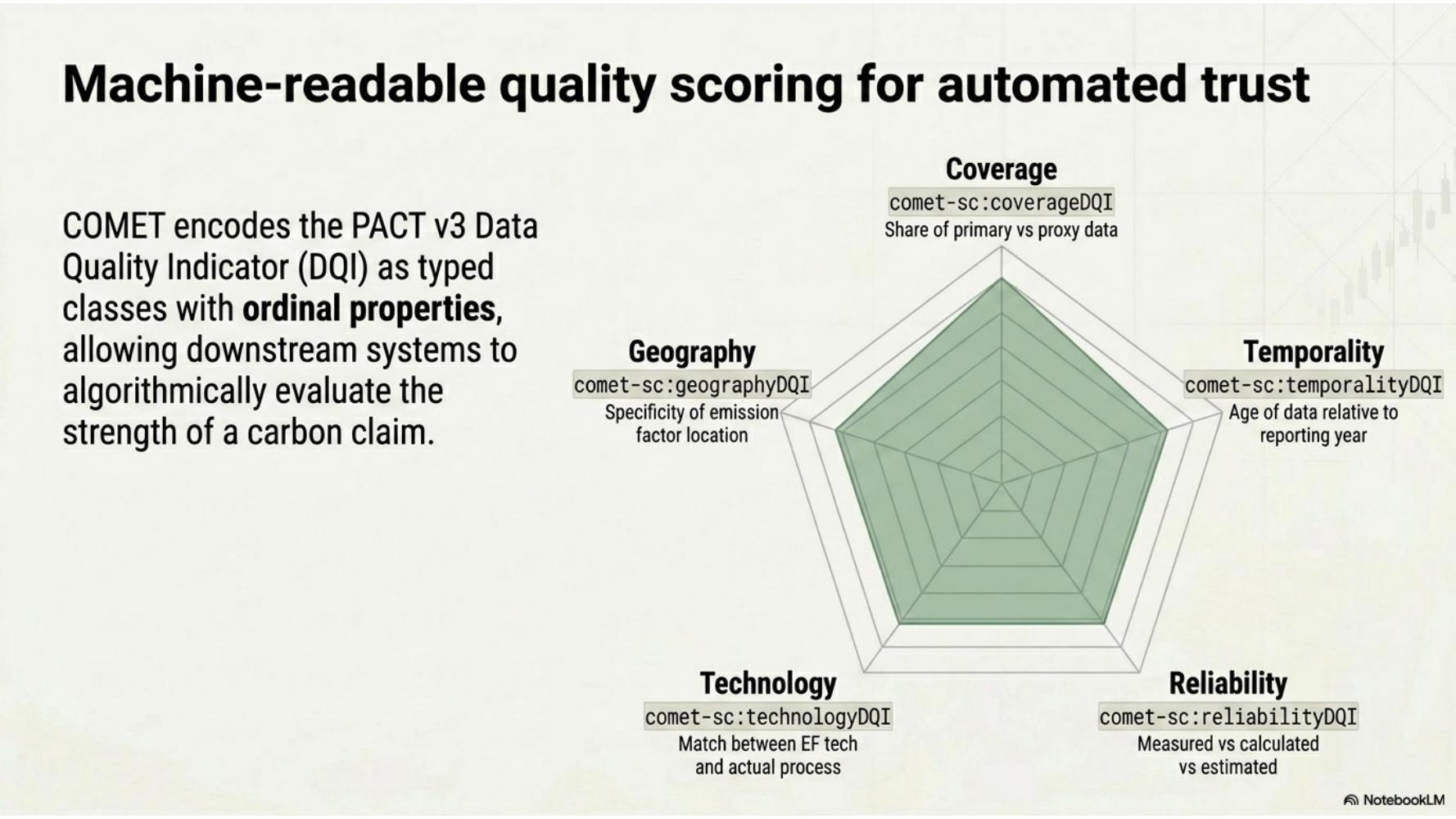
Pentagonal radar chart of five data quality dimensions.
Slide 08 · Data quality
Machine-readable quality scoring for automated trust
COMET encodes the PACT v3 Data Quality Indicator as typed classes with ordinal properties across five axes: Coverage, Geography, Temporality, Technology, and Reliability. Downstream systems can algorithmically evaluate the strength of a carbon claim.
comet-sc:coverageDQI comet-sc:geographyDQI comet-sc:temporalityDQI comet-sc:technologyDQI comet-sc:reliabilityDQI
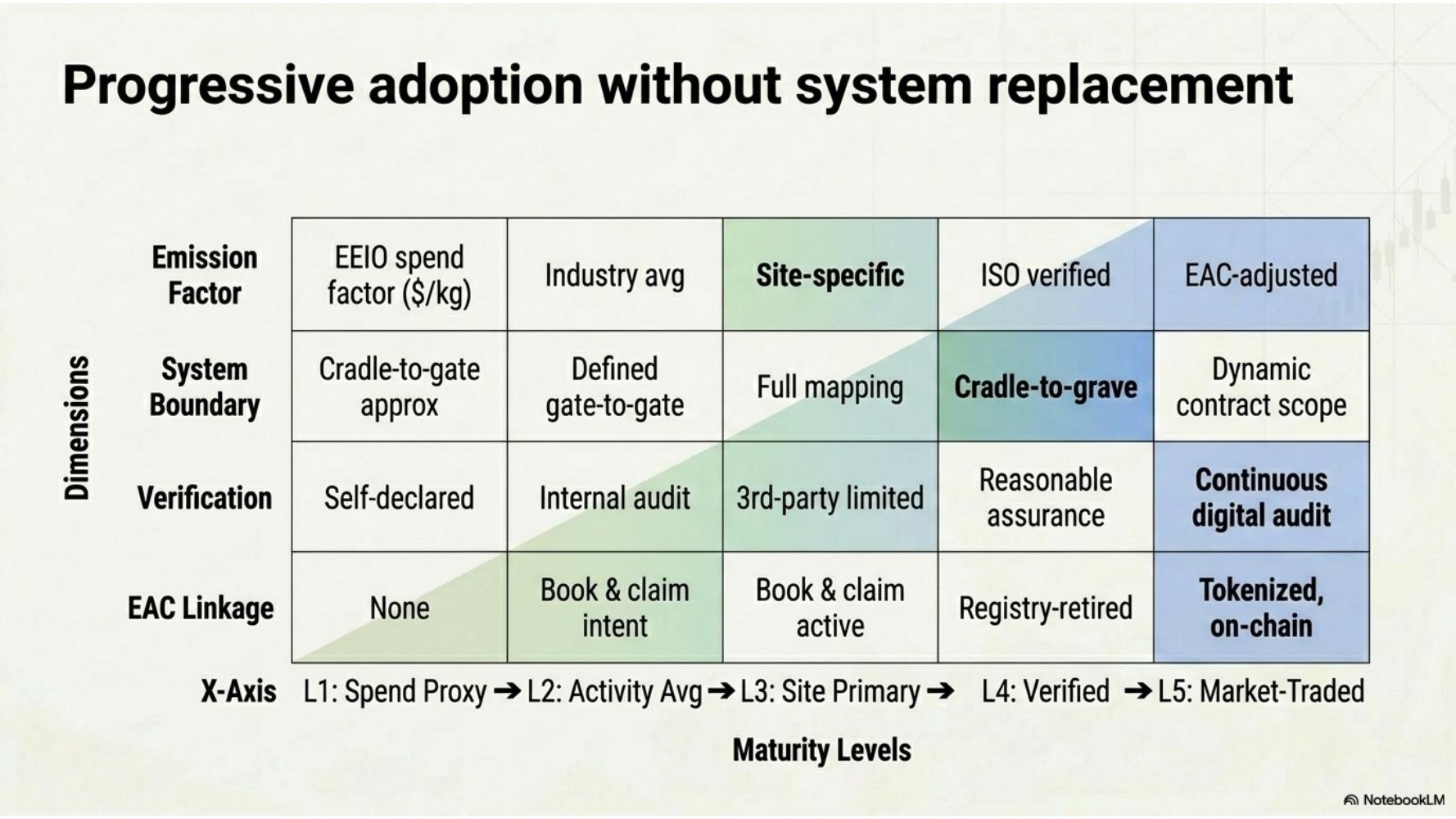
Maturity matrix showing dimensions of emission factor, system boundary, verification, and EAC linkage progressing from L1 Spend Proxy to L5 Market-Traded.
Slide 09 · Maturity
Progressive adoption without system replacement
A 4×5 maturity matrix lets organizations enter at L1 (EEIO spend factors, self-declared, no EAC) and climb toward L5 (EAC-adjusted, continuous digital audit, tokenized on-chain) without ripping out existing tools. Adoption is incremental by design.
L1 Spend Proxy L3 Site Primary L5 Market-Traded
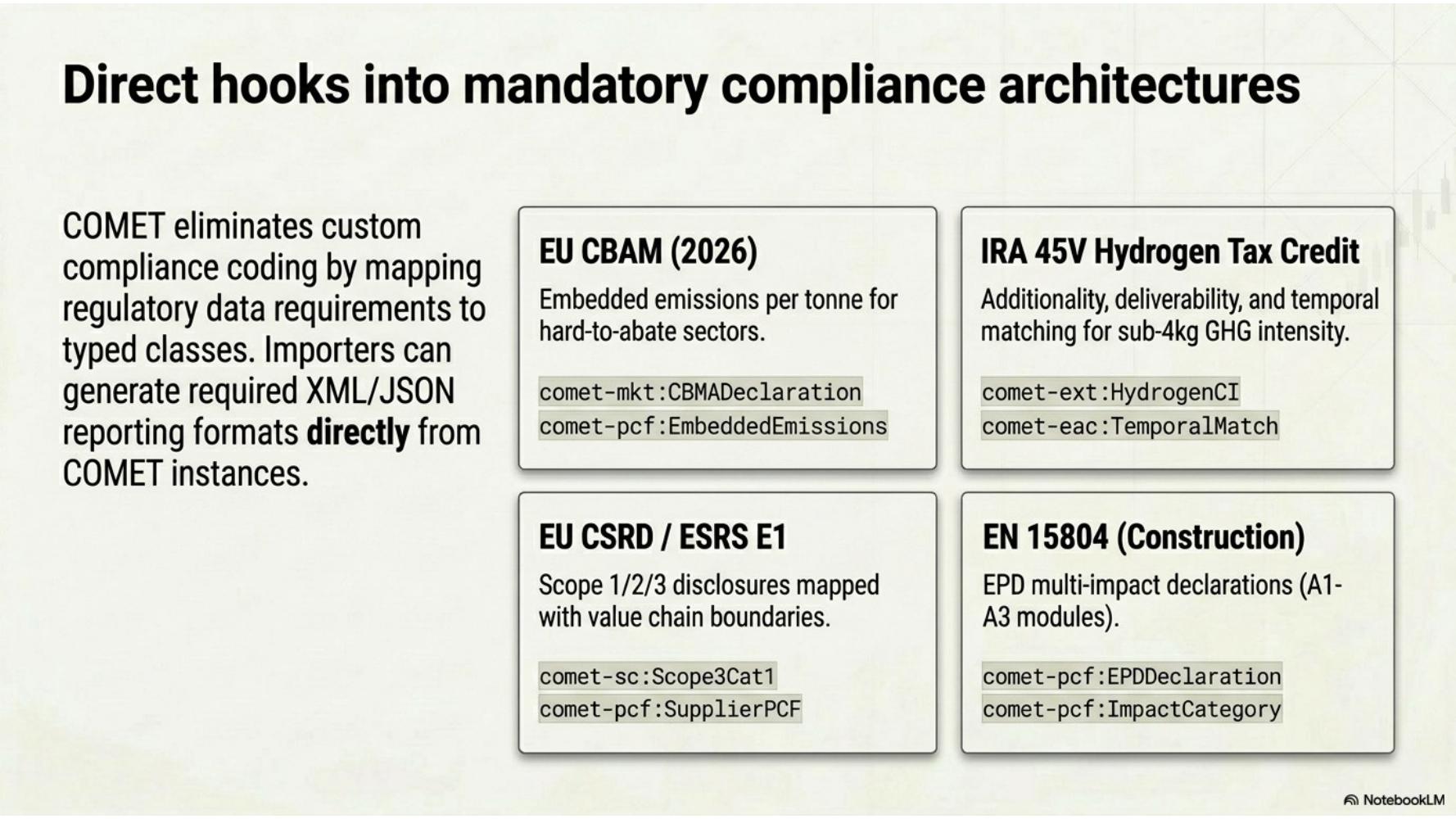
Compliance hooks panel listing CBAM, IRA 45V, CSRD, and EN 15804.
Slide 10 · Regulatory hooks
Direct hooks into mandatory compliance architectures
COMET eliminates custom compliance coding. EU CBAM (2026), IRA 45V Hydrogen Tax Credit, EU CSRD / ESRS E1, and EN 15804 (Construction EPDs) are each mapped to typed classes — importers generate the required XML or JSON directly from COMET instances.
comet-mkt:CBMADeclaration comet-ext:HydrogenCI comet-sc:Scope3Cat1 comet-pcf:EPDDeclaration
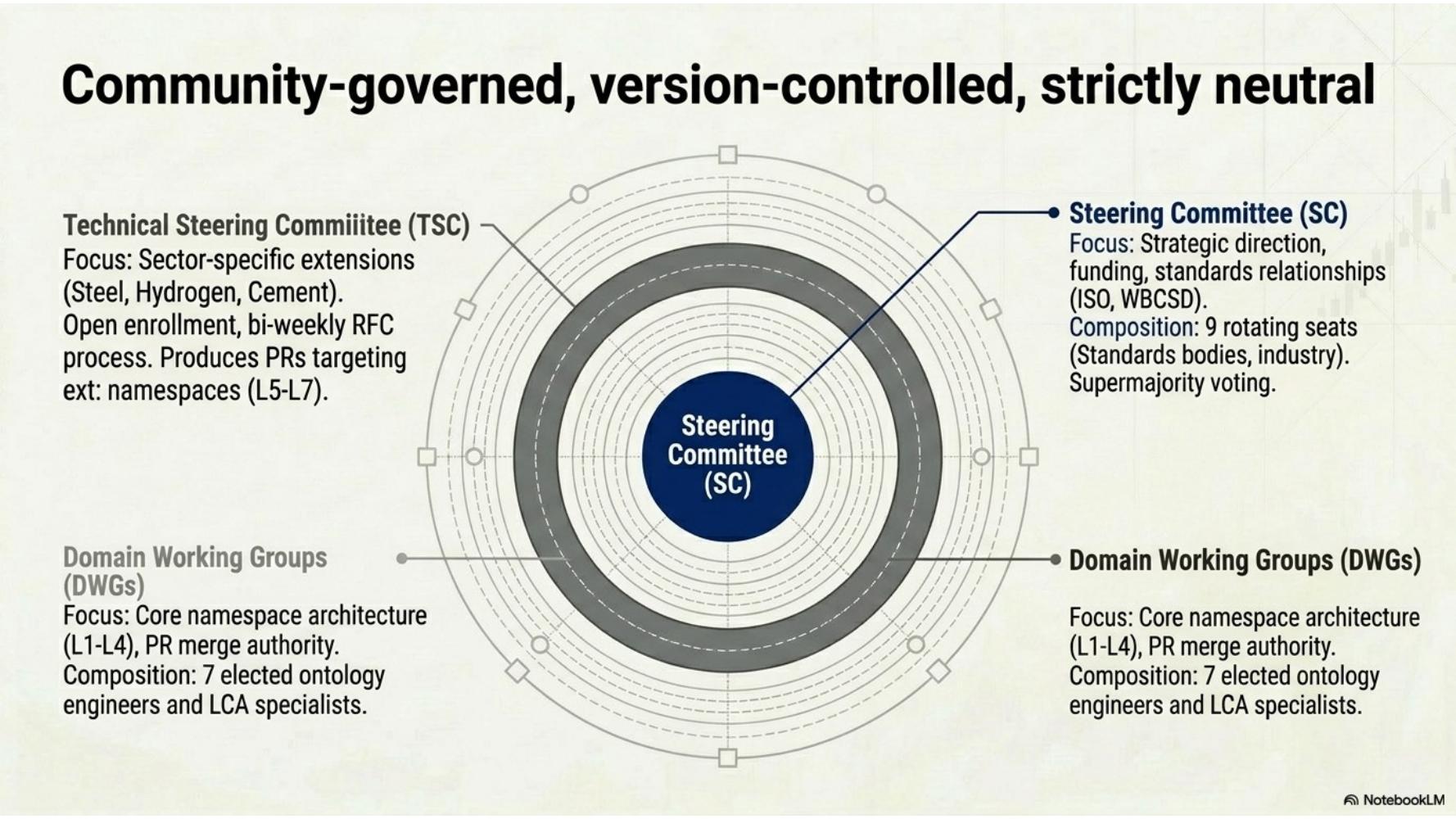
Concentric governance diagram with Steering Committee at center, surrounded by Technical Steering Committee and Domain Working Groups.
Slide 11 · Governance
Community-governed, version-controlled, strictly neutral
Three concentric bodies: a 9-seat Steering Committee (supermajority voting, ISO / WBCSD relationships), a Technical Steering Committee running a bi-weekly RFC process for sector extensions (Steel, Hydrogen, Cement) targeting ext: namespaces, and Domain Working Groups owning core L1–L4 PR merge authority.
Steering Committee TSC DWGs
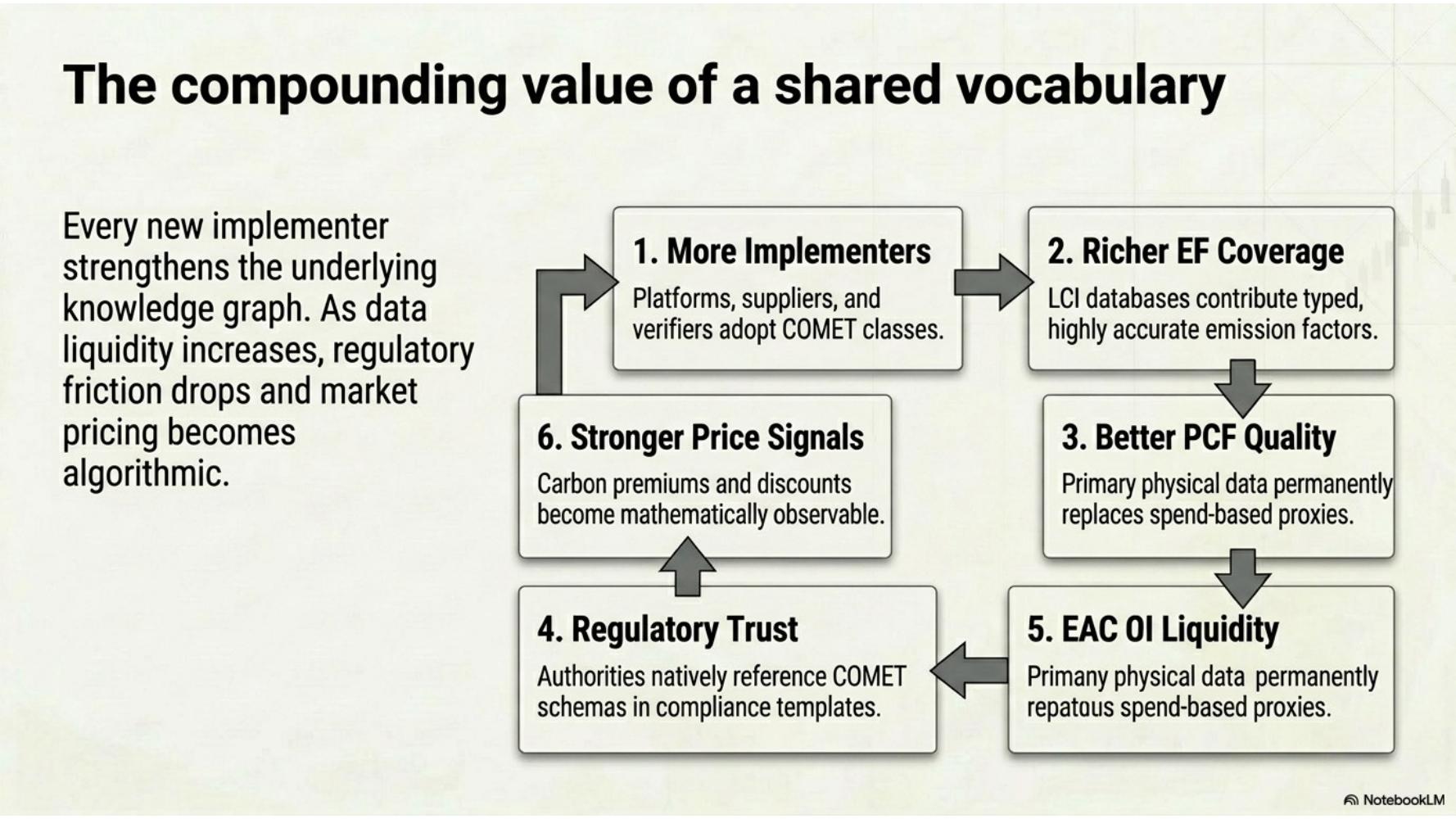
Six-step adoption flywheel with arrows connecting more implementers, richer EF coverage, better PCF quality, regulatory trust, EAC liquidity, and stronger price signals.
Slide 12 · Flywheel
The compounding value of a shared vocabulary
A six-step network effect: more implementers → richer emission factor coverage → better PCF quality → regulatory trust → EAC liquidity → stronger price signals → more implementers. Each new adopter strengthens the underlying knowledge graph for every other adopter.
Network effects Algorithmic pricing
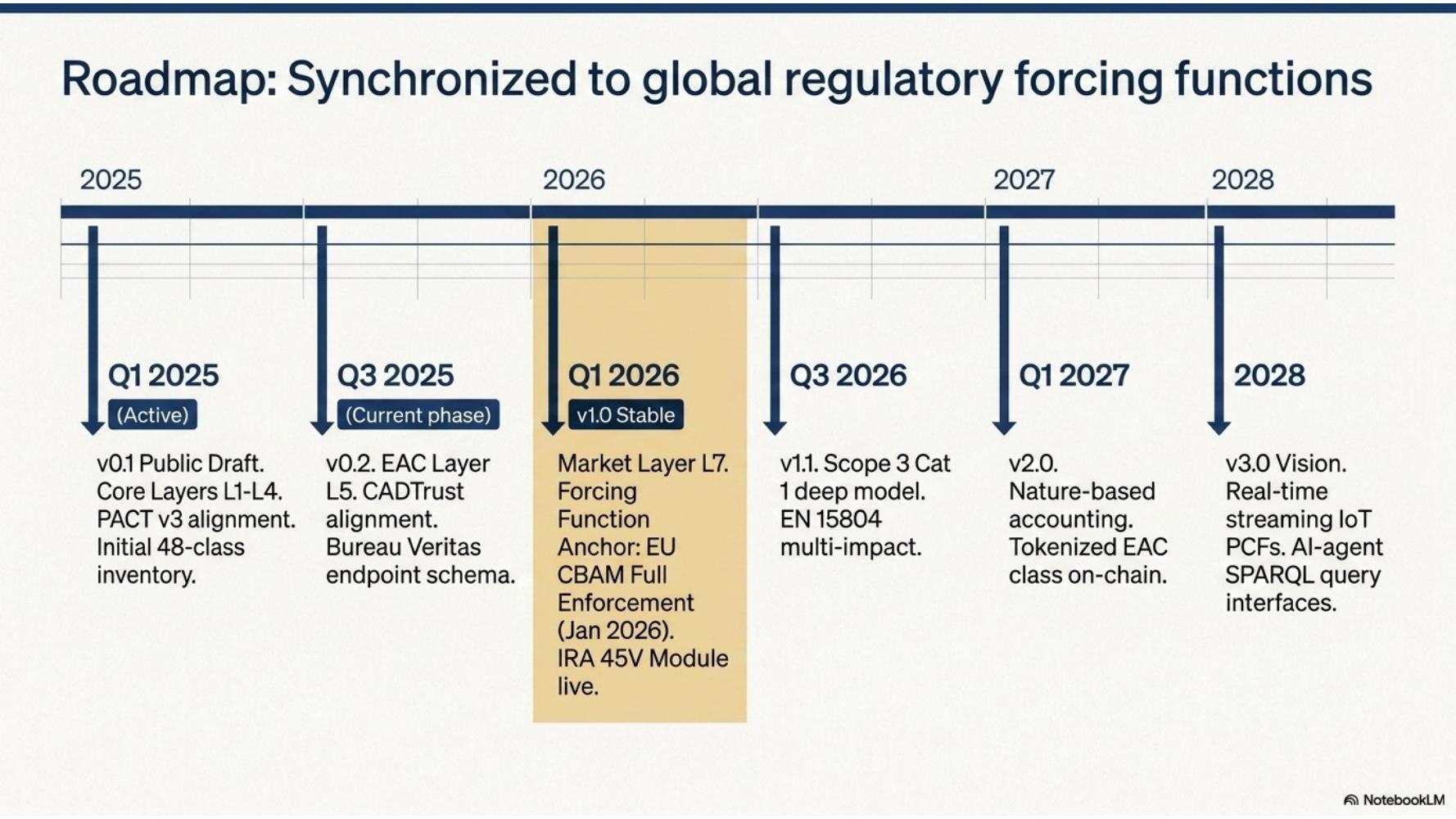
Roadmap timeline from Q1 2025 v0.1 to 2028 v3.0 vision.
Slide 13 · Roadmap
Synchronized to global regulatory forcing functions
Q1 2025 v0.1 Public Draft (active) → Q3 2025 v0.2 EAC Layer + CADTrust → Q1 2026 v1.0 Stable anchored to EU CBAM full enforcement and IRA 45V → Q3 2026 v1.1 Scope 3 Cat 1 + EN 15804 multi-impact → Q1 2027 v2.0 Nature-based, tokenized EAC on-chain → 2028 v3.0 real-time IoT PCFs and AI-agent SPARQL.
v0.1 Active v1.0 Q1 2026 v3.0 2028
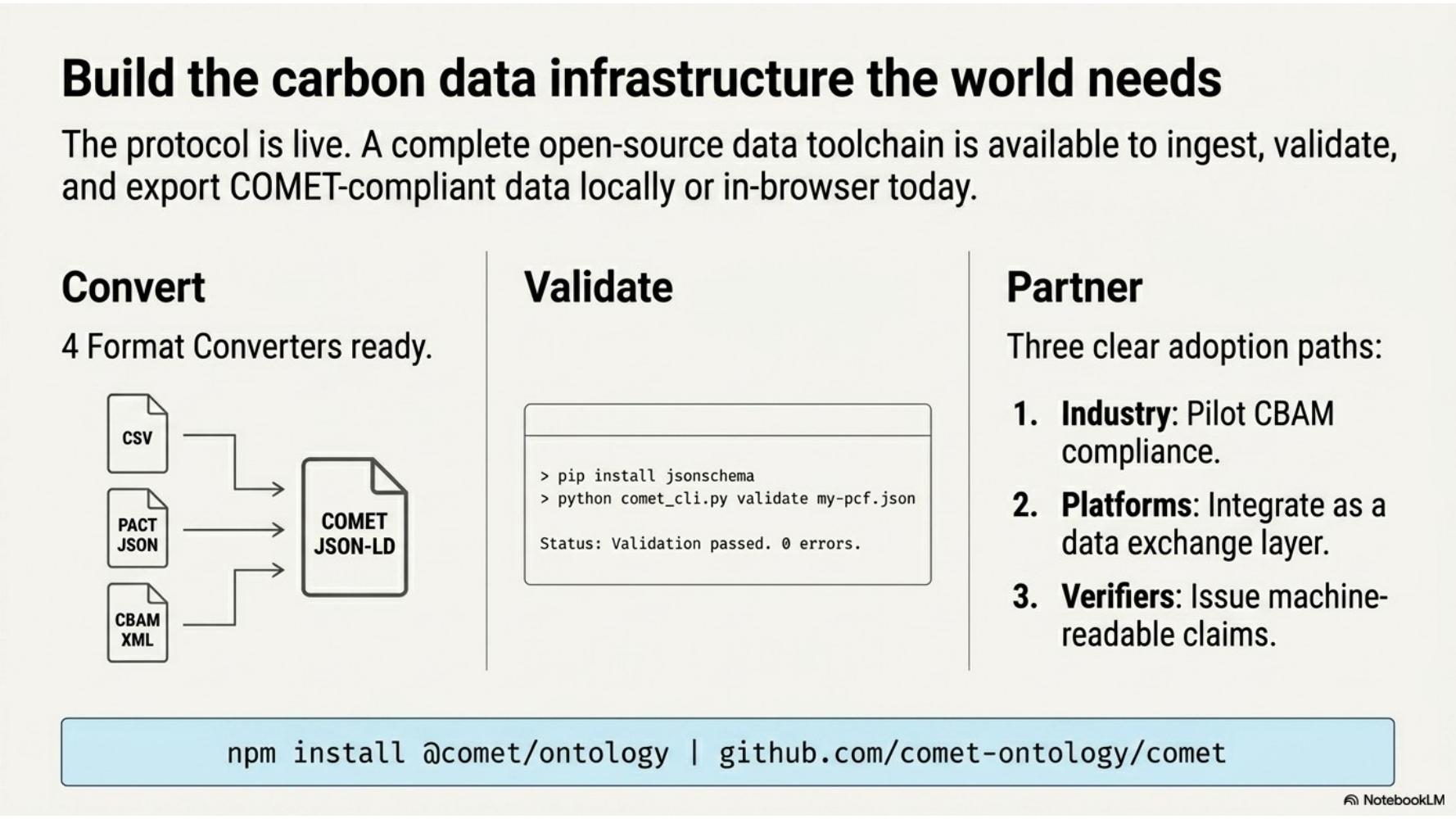
Three-column adoption playbook covering convert, validate, and partner.
Slide 14 · Call to action
Build the carbon data infrastructure the world needs
The protocol is live. Convert: four format converters move CSV / PACT JSON / CBAM XML into COMET JSON-LD. Validate: python comet_cli.py validate my-pcf.json. Partner along three paths — Industry pilots CBAM, Platforms integrate as a data-exchange layer, Verifiers issue machine-readable claims.
npm install @comet/ontology comet_cli.py