New to COMET? Here's the whole thing, in plain language.

An ontology is just a shared dictionary — an agreed list of terms and how they relate. COMET is that dictionary for carbon data. Right now, “one tonne of CO₂” on one platform doesn't line up with the same words on another: different units, boundaries, methods, and emission-factor vintages. COMET defines every term once, so a footprint, a certificate, or a customs declaration means the same thing everywhere.

Think of it like the metric system, but for carbon: shared units and definitions everyone can build on — so data becomes comparable, verifiable, and tradeable across industries and borders.

Below is the entire dictionary — every class, property, value, and standards mapping. Explore it as an interactive map, sort and search the full lookup, or download the whole thing as a spreadsheet.

1168
Terms
177
Classes
225
Properties
7
Layers
392
Standards Maps
649
CAD Trust Fields

Carbon data is everywhere.
None of it speaks the same language.

“Platforms use different units, methods, scopes, and emission factor vintages. Without a shared vocabulary, you cannot compare, verify, or trade carbon data.”

Every company measures carbon differently. Every platform stores it differently. Every regulator asks for it differently. The result is a fragmented landscape where carbon data cannot be trusted, compared, or acted upon at scale. COMET resolves this by providing the shared vocabulary the market is missing.

One ontology. Every standard. Every sector.
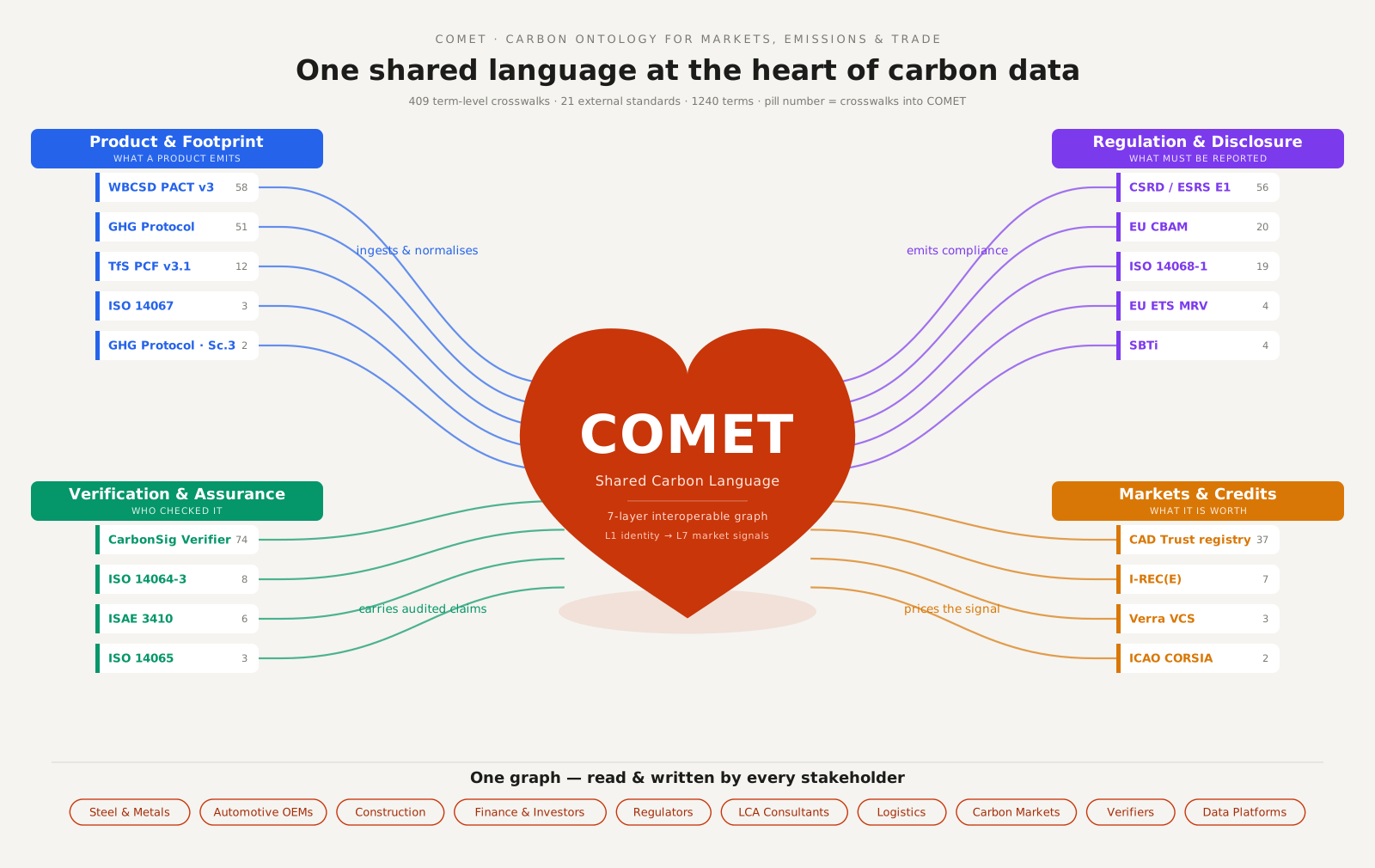
COMET sits at the heart of carbon data interoperability. Four standards domains feed the single COMET graph — Product & Footprint (what a product emits), Regulation & Disclosure (what must be reported), Verification & Assurance (who checked it), and Markets & Credits (what it is worth). Each standard is labelled with its number of term-level crosswalks into COMET, and every stakeholder group reads the same graph.
The standards that produce carbon data all speak different dialects. COMET is the shared language between them — and the single graph every stakeholder reads. Standards and crosswalk counts are generated live from the published alignments.
01

Shared Vocabulary

One ontology maps ISO 14067, PACT v3, GHG Protocol, CBAM, and EAC standards into interoperable classes that any platform can consume.

02

Seven-Layer Stack

From core identity primitives (L1) to market pricing signals (L7), each layer is independently versionable and composable with the rest.

03

Community Governed

Steering Committee, Technical Committee, and open Working Groups. All decisions made via public GitHub with full audit trails.

Built for everyone who touches carbon data.

Industrial Buyers

Equal-footing supplier comparison

Compare supplier PCFs on equal footing. Auto-generate CBAM declarations from structured, verified data.

Carbon Verifiers

Machine-readable claims

Issue machine-readable verification claims. Replace static PDFs with trusted, queryable data objects.

Platform Vendors

Instant interoperability

npm install @comet/ontology — instant interoperability with any COMET-compliant platform.

Regulators

Proven open standard

Reference a proven open standard for CBAM, CSRD, and IRA 45V compliance frameworks.

LCA Practitioners

Universal export format

Export SimaPro and openLCA results in a universal format any downstream system can read without translation.

Financial Markets

Product-level carbon risk

Price carbon risk using verified, product-level data rather than sector averages and disclosure estimates.

Deep Dive

50 quantified use cases across 10 stakeholder groups

Interactive Sankey diagrams, sourced savings metrics, and a “My Use Case” builder that maps your data onto COMET layers.

Explore Stakeholder Benefits →

CBAM is live. The cascade is underway.

Now

CBAM Full Enforcement · Jan 2026

Approximately 4,000 EU importers now require structured carbon data from roughly 40,000 direct suppliers — and hundreds of thousands of sub-suppliers cascading further up each value chain. This is not a reporting exercise. It is a data infrastructure problem that is happening right now. COMET is the shared language this cascade requires.

One vocabulary. Every carbon data standard.

COMET provides the semantic middleware between data producers and consumers. Supply chain platforms, LCA tools, and registries produce data in proprietary formats. COMET’s JSON-LD context injection maps any payload into a shared ontology — so buyers, verifiers, regulators, and carbon markets can consume standardized, machine-readable data without translation.

WBCSD PACT v3

Complete field-by-field mapping

Every PACT v3 ProductFootprint and CarbonFootprint field maps to a COMET class via owl:equivalentClass and owl:equivalentProperty triples. Drop-in JSON-LD @context upgrades any PACT payload to semantic RDF.

EU CBAM

Declaration structure in XML & JSON

CBAM embedded emissions declarations (Reg. 2023/956) mapped to COMET classes with working XML, XSD schema fragments, and CN code coverage for steel, aluminium, cement, hydrogen, and chemicals.

CAD Trust v2.0.2

Full registry interoperability

All 13 CAD Trust tables (project, unit, verification, issuance, label, co-benefit, Article 6 ITMO) mapped into COMET namespaces. 100+ variables aligned for carbon credit registry data exchange.

GHG Protocol & ISO 14067

Scope 3 and product-level coverage

GHG Protocol Scope 3 Categories 1–15 mapped to COMET supply chain and PCF classes. ISO 14067 Section 7 required elements fully covered in L4 PCF layer.

Convert, validate, and export — today.

COMET ships with a complete, open-source data toolchain so you can start working with COMET-compliant data immediately. Every tool runs locally (Python CLI) or in your browser (Playground) — no accounts, no API keys, no vendor lock-in.

Ingest

4 Format Converters

Convert CSV spreadsheets, PACT v3 JSON, CBAM XML declarations, and CAD Trust registry data into COMET JSON-LD with a single command. Field-level mappings cover 44 PACT fields, all CBAM CN codes, and 13 CAD Trust tables.

Validate

JSON Schemas + CLI

Three JSON Schemas (PCF, EAC, Core) validate any COMET document against the ontology. The comet validate CLI gives structured errors with fix suggestions. Batch mode validates entire directories.

Export

3 Egress Formats

Export COMET data back to PACT v3 for WBCSD exchange, CBAM XML for EU regulatory filing, or flat CSV for spreadsheet workflows. Round-trip fidelity ensures nothing is lost in translation.

Browser

Data Playground →

Paste or upload data in any supported format and instantly convert, validate, and download COMET JSON-LD — entirely in your browser. No install required. Try it with the built-in steel, aluminium, and DAC credit examples.

CLI + Python

Command-Line Toolkit

pip install jsonschema
python comet_cli.py validate my-pcf.json
python comet_cli.py convert data.csv --from csv --to comet
CSV templates, 6 worked examples (steel, aluminium, DAC credits, PACT, CBAM, CAD Trust), and full documentation included.

Everything you need to build with COMET.

New — I-REC(E) Electricity · comet-irec:

I-REC(E) Renewable Energy Certificates

The Evident I-REC Code for Electricity v1.13 and Standard Forms SF-02 / SF-04 mapped onto the stack — reusing comet-eac: for the certificate (subType IREC), comet:Site for facilities and comet-eac:RetirementEvent for redemption. New terms for the SF-04C multi-fuel co-firing allocation, the QR-verified Redemption Statement, and the anti-double-counting declarations, with SHACL and a JSON-LD converter.

New — TfS PCF Data Model · comet-tfs:

TfS PCF v3.1 (Chemicals)

All 131 fields of the Together for Sustainability PCF Data Model v3.1 (Sept 2025) mapped onto the seven-layer stack. Twelve owl:equivalentClass bridges, 24 new classes for the PACT-aligned A–H emission decomposition, mass balancing, CCU/CCS credits, data-quality (PDS + DQR), verification shares, and the Attestation of Conformance. Interoperable with WBCSD PACT and Catena-X.

New — ISO 14068-1 Extension

Carbon Neutrality (ISO 14068)

How ISO 14068-1:2023 maps onto the seven-layer stack. Eighteen owl:equivalentClass bridges to existing COMET, twenty-four new classes for Plan / Pathway / Claim / Report, and stakeholder benefits for industry, finance, verifiers, and regulators.

New — PCR Japan Extension · comet-pj:

PCR Japan / SuMPO EcoLeaf

Bilingual (Japanese/English) extension for the SuMPO EPD Japan program. 76 PCRs harvested from ecoleaf-label.jp, 85 requirements extracted, 9 new classes including SuMPOPCRDocument, a 13-concept SKOS product field taxonomy, SHACL shapes, and full 日本語 labels for all COMET core terms. Data source: PCRbase.

New — CarbonSig PCR Extension · comet-pcr:

Product Category Rules (comet-pcr)

PCR method vocabulary extending L4 (PCF): a structured, versioned PCRDocument reifying the PCRReference stub, the keystone governedByPCR link, plus CutOffRule, DeclaredModule, ReferenceServiceLife, and PEF terms. Now published in the COMET term graph (17 terms). Source: PCRbase.

New — Standards Alignment · csig:

CarbonSig Verifier Export v4

74 SKOS crosswalks mapping the CarbonSig Verifier Hub export contract (v4) onto COMET — emission factors (L2), supply-chain flows & scope 1/2/3 (L3), PCF declarations (L4), and verification status (L6) — each tagged High / Medium / Low certainty. Now part of the 392 standards-alignment crosswalks.

New — ASI Aluminium Extension · comet-asi:

Aluminium Stewardship (ASI)

Maps the aluminium-specific variables of the ASI Performance Standard V3 (Principle 5 — GHG) and Chain of Custody Standard V2 onto COMET: ASICertification, CoCClaim, production route & anode-effect metrics. 38 terms typing only the gaps — Scope 1/2/3, site and verifier identity are reused. Includes a CBAM alignment and SHACL shapes.

Explainer Video & v0.1 Deck

Materials: A Shared Carbon Language

Six-minute narrated walkthrough of COMET paired with the 14-slide v0.1 Carbon Protocol deck. Includes slide-by-slide summaries linking each visualization to the ontology layers, namespaces, and governance model.

Video — MP4 Download

COMET Explainer Video

Six-minute narrated walkthrough of the protocol — market problem, JSON-LD @context injection, the seven-layer stack, and standards interoperability. Suitable for first-conversation context with partners and regulators.

Presentation — Download PPTX

Carbon Protocol Deck (v0.1)

Fourteen slides from carbon variance and the seven-layer architecture through compliance hooks (CBAM, IRA 45V, CSRD, EN 15804), governance, the adoption flywheel, and the 2025–2028 roadmap.

From foundations to global infrastructure.

Phase 1 · Complete

Q1–Q2 2025

Foundations & First Adopters

  • Core ontology & 7-layer stack
  • PACT v3 full alignment (44 fields)
  • JSON Schema validation
  • CBAM declaration class
  • Data toolchain (CLI, converters, playground)

Phase 2 · Current

Q3 2025 – Q1 2026

Supply Chain & Verification

  • Full supply chain module
  • CAD Trust verification layer
  • EAC hierarchy & registry interop
  • Verification connector pilots

Phase 3

Q2 2026 – Q4 2026

Market Layer & Sectors

  • Pricing signals layer (L7)
  • Steel / H2 / Chemicals / Aluminium WGs
  • CSRD mapping
  • v1.0 stable release

Phase 4

Q1 2027 – Q4 2027

Global Scale & Nature

  • Real-time IoT streaming
  • TNFD biodiversity layer
  • Tokenized EAC rails
  • AI query interface

Build the carbon data infrastructure the world needs.

COMET is an open standard — but adoption requires collaboration. We are seeking founding partners from industry, platforms, verifiers, and regulators to shape the ontology, pilot integrations, and join the governance structure.

Industry

Steel, aluminium, chemicals, and cement producers piloting COMET for CBAM compliance and supply chain data exchange.

Platforms

Carbon accounting, LCA software, and supply chain platforms integrating COMET as a data exchange layer.

Verifiers

Assurance firms issuing machine-readable verification claims that flow through the COMET network.

Regulators

Policy bodies referencing COMET for CBAM, CSRD, IRA 45V, and voluntary carbon market compliance frameworks.

Get in touch →

ng@carbonsig.com  ·  Nick Gogerty  ·  Carbon Finance Lab